
Quick answer: A 30-day window can realistically move a messy credit file 20 to 60 points if you focus on three things: removing reporting errors, paying card balances down before each statement's closing date, and not opening or closing anything new. It will not undo accurate late payments, charge-offs, or recent bankruptcies.
If you've got 30 days before you need to apply for a loan and you know your credit isn't where it should be, you're in a different category than most people Googling "improve my credit." You don't need a year-long plan. You need a sprint. Day-by-day. Honest about what works in 30 days and what doesn't.
Here's the truth I learned watching thousands of files cross my desk: a 30-day window is short, but it's not nothing. The borrowers who use it well can move 20 to 60 points in a month if they hit the right levers in the right order. The borrowers who panic and start opening cards or applying everywhere they can will go backwards. Let's run the right plan.
Before you start: know your statement closing dates
This is the single most important piece of information in this whole article, and most people don't even know it exists. The credit bureaus don't see your card balance on your due date. They see whatever balance is on your account on the day your statement closes (usually about 21 to 25 days before the due date).
So if your card statement closes on the 8th, the balance reported to the bureaus is whatever was on it at midnight on the 8th. Pay it down on the 7th and the bureaus see a low balance. Pay it down on the 15th (when the bill is due) and the bureaus already saw it high. The score doesn't move.
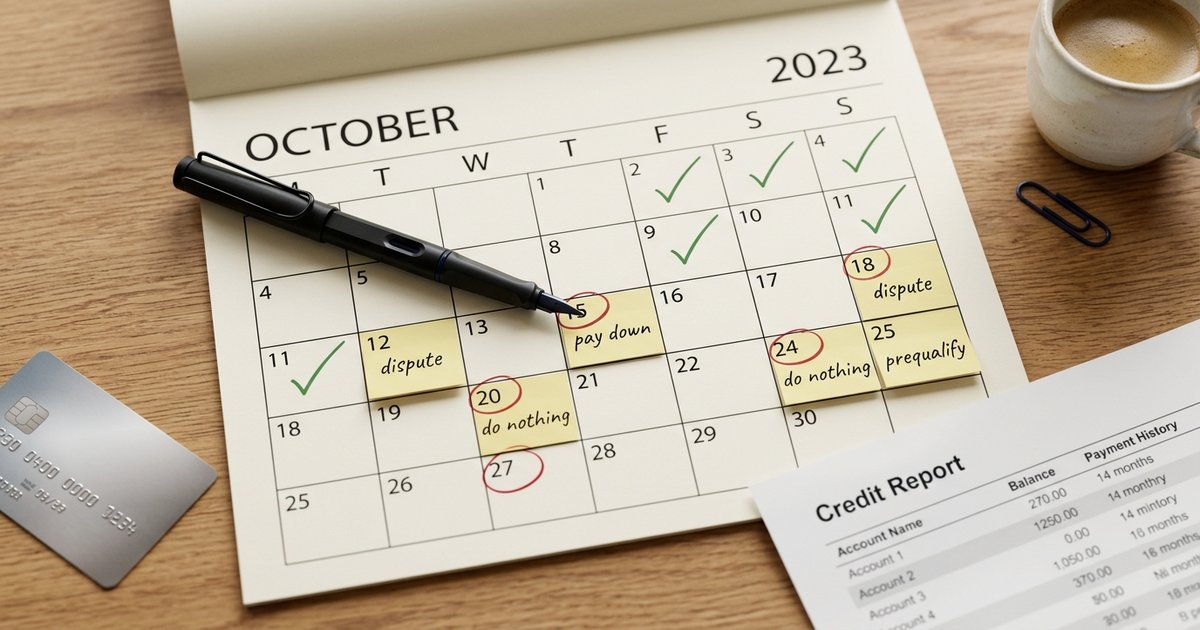
Open every credit card you have. Find the statement closing date on each one. Write them down. This calendar drives everything else. (For why utilization carries so much weight relative to installment debt, see why a small card balance hurts more than a big car loan.)
Days 1 to 3: Pull all three credit reports and read them line by line
Go to AnnualCreditReport.com. It's free, it's federally mandated, and you can pull all three (Equifax, Experian, TransUnion) every week. Don't pay for a service. Don't sign up for a credit-monitoring trial. Just pull the reports.
Print them or save them as PDFs. Read every single line. You're looking for:
- Accounts you don't recognize
- Late payments that weren't actually late
- Balances that are wrong
- Accounts marked "open" that you closed years ago
- Collection accounts you've already paid
- Hard inquiries you didn't authorize
- Personal info that's wrong (old addresses, name variations)
The FTC's research found that roughly 1 in 5 consumers has at least one error on their credit report, and 1 in 20 has an error serious enough to result in worse loan terms. Errors are the rule, not the exception.
Days 4 to 7: File disputes for any errors
For every error you found, file a dispute directly with the bureau showing the error. You can do it online at each bureau's site, but I tell people to mail it. Certified, return receipt. Paper trail.
Under the Fair Credit Reporting Act, the bureau has 30 days to investigate. If they can't verify the item, they have to remove it. That window fits inside your sprint, but barely. Don't wait until day 14 to file disputes. Get them in by day 7.
Use plain language. "The account on page 2, account number ending 4471, shows a 30-day late in March 2024. This is incorrect. I have attached the bank statement showing the payment was made on March 8, before the due date. Please remove this late payment from my report." That's the format. Specific, calm, with attached proof.
If the bureau verifies the item and you still think it's wrong, the next step is a complaint with the CFPB at consumerfinance.gov/complaint. That escalates the file and gets attention.
Days 8 to 14: Pay cards down before each statement closing date
This is the lever that moves a score the fastest. Credit utilization (your balance divided by your credit limit) has no memory. The moment a lower balance gets reported, your score recalculates. There is no "earning back" required. The number changes the next month.
The thresholds that matter, per Experian's utilization breakdown:
- Under 10 percent total utilization: excellent
- Under 30 percent: solid
- 30 to 50 percent: starts hurting
- Over 50 percent: serious drag
- Over 90 percent: emergency
The trick is that lenders also look at per-card utilization, not just overall. If you have three cards and one of them is at 88 percent, that one card hurts your score even if your overall utilization is 22 percent. Spread balances out, or pay the high one down first.
Now bring back the calendar. Look at the statement closing date for each card. Pay each card down to under 10 percent of its limit at least three days before its statement closes. Not the due date. The closing date. Some folks call this the "15/3 rule" (pay 15 days before, 3 days before), and it's not magic, but timing payments around the closing date is real and it works.
If you can't pay everything down to 10 percent, prioritize: highest-utilization card first, then highest-balance card, then the rest.
Days 15 to 21: The "do nothing" window
This week is about restraint. Do not:
- Apply for any new credit cards
- Accept "instant credit" offers at checkout
- Co-sign on anything
- Close any old credit cards (closing kills your average account age and reduces your total available credit, which spikes utilization)
- Let any payment go past due, on anything
I know that's frustrating. Doing nothing feels passive. But every hard inquiry is a small score drop, and personal loans don't get the rate-shopping deduplication that mortgages and autos get. Each application is its own hit. (For the full mechanics, see our walkthrough on shopping bad-credit loans without tanking your score.)
What you can do during this week: keep paying balances down further, track which disputes have come back, and start researching lenders that offer prequalification with a soft pull.
Days 22 to 28: Authorized user (only if it makes sense)
Adding yourself as an authorized user on a relative's well-managed credit card can help if their card has a long history, low utilization, and clean payment record. Their account history gets reported to your file.
Two honest caveats. First, FICO 9 and later models filter out non-related authorized-user accounts to prevent "credit piggybacking" gaming, so the boost depends on which scoring model the lender uses. Second, the person whose card you're being added to is taking on a small amount of risk if you ever get the physical card and run it up. Most don't even send the card to the authorized user.
If you go this route, ask the cardholder to call the issuer and add you. The new account usually shows up on your report within one to two billing cycles. If you're outside the 30 days when it shows up, you'll catch it in the next pull.
Days 29 to 30: Pull a fresh score, then soft-pull prequalify
Pull your reports again. Compare them to the day-1 versions. Errors removed? Balances reported lower? Any new inquiries you didn't expect (sometimes a creditor will report something out of nowhere)?
Then prequalify with three to four lenders that use soft pulls. Soft pulls don't affect your score. You'll get rate estimates and likely approval amounts before any hard pull happens. Our companion piece on soft-pull vs hard-pull pre-qualification covers the language to look for.
Compare the offers on APR (not monthly payment), origination fees (some charge up to 8 percent), term length, and any prepayment penalties. The cheapest monthly payment is often the most expensive total cost.
Then submit one formal application to your top choice. One. Not three.
What this sprint can't fix
I'm going to be straight with you, because nobody else will be.
A 30-day sprint cannot:
- Remove an accurate late payment, charge-off, or collection from your report
- Reverse a recent bankruptcy
- Build credit history from scratch (thin file)
- Undo a hard inquiry that's already on your report
- Move you from a 540 to a 720 in a month
If your starting score is 540 because of multiple charge-offs, this sprint will help, but it won't transform you into a prime borrower. You may still need a co-borrower, a secured loan, or 90 to 180 more days of work. (If you're starting from a true blank file rather than a damaged one, see how long it takes to build credit from zero.)
If your starting score is 660 with one late payment and high utilization, this sprint can absolutely lift you into the 700s and into a much better rate tier.
The score you can move depends on where you started.
If your score still isn't there: the 90-day version
If you finish day 30 and you're still not where you need to be, extend the work. The next 60 days adds:
- Building a longer record of low utilization (the score keeps adjusting upward as you maintain the new balance pattern)
- Letting recent inquiries age (they stop affecting your score after about 12 months but soften noticeably after 6)
- Adding a small credit-builder loan from a credit union to deepen your file
- Continuing to dispute and follow up on any unresolved items
You don't need to apply for the loan on day 30 just because you started the sprint on day 1. The loan will still be there in 60 days. Often at a better rate than your file would have qualified for today.
Trust Point Loans is not a lender or broker, and we are not a credit-repair company. We don't dispute items on your behalf or "fix" your credit. We tell you how the system works so you can do the work yourself. Anybody promising to "boost your score" for a fee is selling you something you can do for free.
Common questions about the 30-day credit sprint
How much can my credit score really improve in 30 days?
Realistically, 20 to 60 points is achievable for borrowers with high utilization, errors on the report, or both. Bigger jumps are possible but uncommon. The starting point matters: thin or already-clean files move less than messy ones.
Should I pay my credit card before the due date or before the statement closing date?
For maximum credit-score benefit, pay before the statement closing date. The due date is for avoiding late fees. The closing date is what determines the balance reported to the bureaus.
Will paying off a collection account remove it from my credit report?
Not automatically. A paid collection still shows up, just marked "paid." Some collectors will agree to a "pay for delete" arrangement in writing before you pay. Get any such agreement in writing first, never on a phone call.
Does closing old credit cards help my credit score?
Almost always no. Closing a card reduces your total available credit (raising utilization) and shortens your average account age over time. Leave old cards open and use them once or twice a year so the issuer doesn't close them for inactivity.
Is the 15/3 credit card rule a real thing?
It's a popular tactic, not an officially endorsed mechanism. The underlying logic (paying balances down before the statement closing date) is real and effective. The specific 15-and-3 split isn't required.
How long do hard inquiries affect my credit score?
Hard inquiries stay on your report for 24 months but typically stop affecting your FICO score after about 12 months, with most of the impact fading much sooner. According to myFICO, the typical impact of a single inquiry is less than five points.