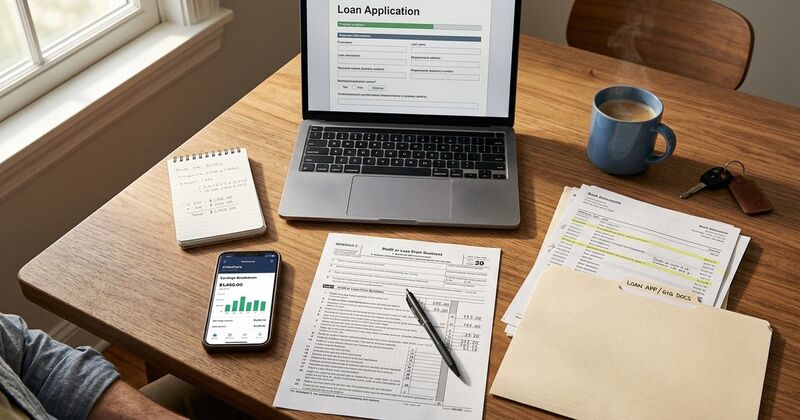

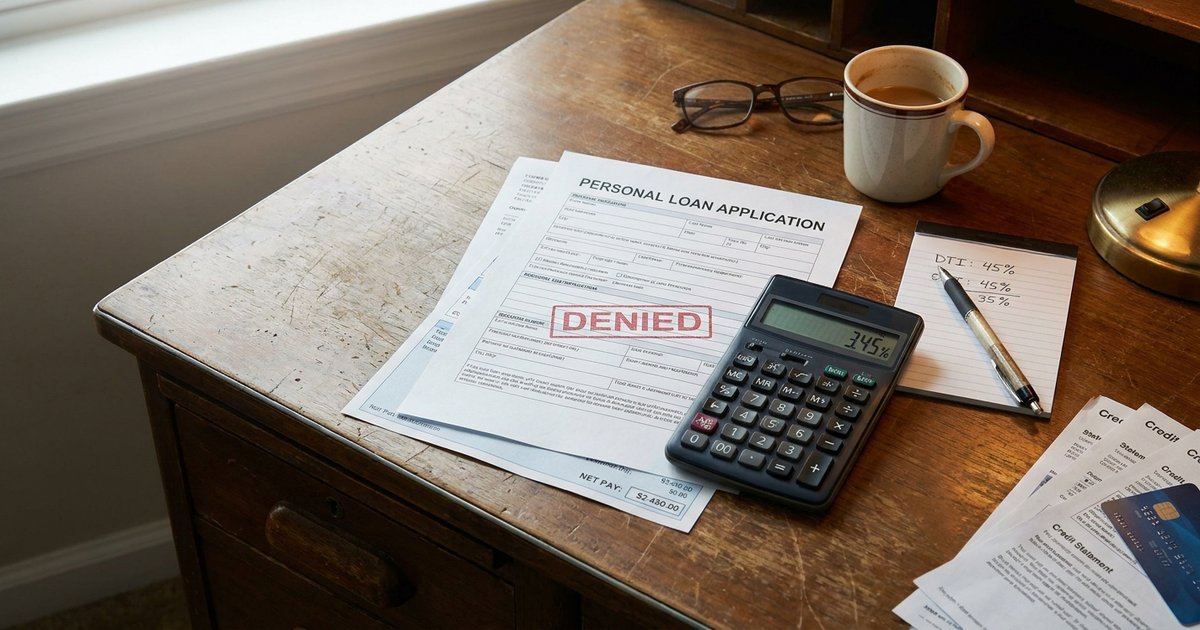
Quick answer: A job does not approve loans, math does. The most common reasons a steady-paycheck borrower gets denied are debt-to-income ratio, credit utilization (especially on the day your statement closes), recent hard inquiries, a thin file, short job tenure, payment-to-income limits, and asking for more than your file supports. Each is fixable in 30 to 60 days.
You make $72,000 a year. You've been at the same company for four years. You've never bounced a check in your life. And the lender just told you no.
I get it. That's the part that stings the most. You did everything you were supposed to do, and a faceless underwriter still kicked the application back. After 28 years on the lending side of the desk, I can tell you something most people never hear: a job does not approve loans. Math approves loans. Let's go through the math the way an underwriter does.
First, read the adverse action notice. The whole thing.
Federal law (the Equal Credit Opportunity Act, enforced by the CFPB) requires a lender to send you a written notice within 30 days when they deny your application. It has to list the specific reasons. Not "credit history." Not "could not approve at this time." Specific reasons.
If yours is vague, you have the right under Regulation B to write back and ask for the actual reasons. Do that. The lender has to answer. And if they used your credit report to deny you, the Fair Credit Reporting Act says they have to tell you which bureau they pulled and remind you that you can get a free report from that bureau. Take advantage of that. You can't fix what you can't see.
Once you have the real reasons in writing, almost every denial fits into one of seven buckets. I'll walk through them. (For a deeper dive on what changes between pre-approval and the final underwriting decision, see why pre-approved loans get denied at final underwriting.)
Reason 1: Your DTI math is not their DTI math
Debt-to-income ratio is the number that quietly disqualifies more "good" borrowers than anything else. The CFPB's plain-language DTI explainer walks through the calculation: take every required monthly debt payment you have (car, student loans, minimum credit card payment, child support, the mortgage or rent if they count it) and divide it by your gross monthly income.
Most personal loan lenders want to see DTI under 45 or 50 percent, and a lot of them want it under 36 percent for a good rate. Anything between 36 and 49 percent puts you in borderline territory. Above 50 and the algorithm doesn't even read the rest of your file.
Here's where people get blindsided. Say you make $6,000 a month gross. You have a $450 car payment, $200 in student loans, and a credit card with a $4,800 balance and a $145 minimum payment. That's $795 in monthly debt before anyone added the new loan you're asking for. Add a proposed $300 personal loan payment and you're at $1,095, or about 18 percent. That sounds fine.
But if the lender counts your $1,800 rent (some do, some don't), suddenly you're at 48 percent. Right at the edge. One more obligation and you're out.
Run the numbers honestly before you apply again. Pretend you're the underwriter and your job is to find a reason to say no.
Reason 2: Your credit utilization is hurting you despite a low balance
This one trips up smart borrowers all the time. Utilization is the percentage of your available revolving credit you're using. Experian's utilization explainer notes that exceptional-credit borrowers average roughly 7 percent utilization. Real damage starts above 30 percent.
The wrinkle: utilization is calculated on the balance reported to the bureaus, which is usually your statement balance, not your current balance. So if you pay your card off in full on the 25th but your statement closes on the 5th with a $2,400 balance on a $3,000 limit, your reported utilization for that month is 80 percent. Your card looks maxed out to the scoring model even though you don't actually owe a dime.
Want to fix it? Pay the card down before the statement closes. Not when the bill is due. When the statement cuts.
Reason 3: Recent inquiries from car shopping or apartment hunting
Hard inquiries individually are small (myFICO says less than five points for most people on a single pull), but they stack. If you applied for a car loan two months ago, signed a lease where the landlord pulled your credit, and then applied for a credit card during a checkout promotion, the lender sees a borrower who looks like they're trying to grab credit anywhere they can get it.
And here's the kicker most folks don't know: personal loans do not get the rate-shopping grace period that mortgages and auto loans get. If you "rate-shop" three personal loan lenders in a week, that's three full hits. Use prequalification with soft pulls before you formally apply anywhere. Our walkthrough on shopping personal loans without tanking your score explains the right sequence.
Reason 4: Thin file. Long history, but only one or two accounts.
I once had a customer come in furious because she'd had the same Visa for nine years, perfect payment history, never missed a beat, and another lender still rejected her loan application. Her credit report had exactly two tradelines. That's it.
The scoring model can't do much with that. It needs depth. Different account types, multiple lines, payment patterns over time. A thin file says "I don't have enough data on this person to know what they'll do." That's not the same as bad credit, but a lender can't approve a maybe.
The fix is slow. A second credit card kept at low utilization, a small credit-builder loan from a credit union, an authorized-user spot on a relative's older account. None of it works in 30 days. Plan for 6 to 12 months. (If you are starting from a true zero, our piece on how long it actually takes to build credit from zero lays out the realistic timeline.)
Reason 5: Job tenure rules nobody tells you about
A lot of lenders want to see you in your current job for at least 60 days, and some want six months or a year. If you started a new role three weeks ago (even if it's a promotion, even if it pays more), you can get rejected for "insufficient employment history" while making more money than ever.
This isn't universal. Some lenders accept a job offer letter or 30 days of pay stubs. But if you just changed jobs and you have a choice, wait. Or apply with a lender whose underwriting guidelines you can read in advance.
Reason 6: Payment-to-income, not just debt-to-income
Some lenders run a second test on top of DTI: how big is the proposed monthly payment compared to your monthly income? They want the new loan payment alone to fit inside a comfortable percentage of what you earn, often 10 to 15 percent.
If you're asking for a $25,000 loan over 36 months at 15 percent APR, that's roughly $866 a month. On a $4,500 net monthly income, that one payment is 19 percent. The DTI may pencil out. The payment-to-income test still kills it.
Stretching the term to 60 months drops the payment to about $595. That's a different conversation with the same lender. Sometimes you don't need a different loan, you need a different structure.
Reason 7: You asked for too much
If your file supports a $10,000 loan and you ask for $30,000, the system doesn't counter-offer. It denies you. A lot of lenders won't even let an underwriter manually adjust the request.
Look at the loan request size relative to your income. A rough rule of thumb on the underwriting side: most personal loans get approved at 25 to 50 percent of annual income, max. If you make $50,000 a year, asking for $40,000 unsecured is a heavy lift unless your credit is excellent. Ask for $15,000. Get approved. Live with it.
What to do in the next 30 days before you reapply
Don't run out and apply somewhere else tomorrow. That's the most expensive thing you can do right now. Every fresh denial is another inquiry on your file.
Here's the order I'd run it:
- Pull all three credit reports for free at AnnualCreditReport.com. Read every line.
- Dispute any errors directly with the bureau in writing. They have 30 days to investigate under FCRA.
- Pay your credit cards down before the statement closing date, not the due date.
- Don't open or apply for anything else for the next 30 to 45 days. No new cards. No "buy now pay later." Nothing.
- Run your real DTI on paper. Including rent. Including the proposed payment.
- When you're ready, prequalify with three lenders that use soft pulls. Compare APR, not monthly payment.
If you have a real deadline coming up, our 30-day credit sprint guide walks you through the day-by-day version of this.
Your rights if you suspect something else is going on
If the denial reasons don't add up to your file, or if you have reason to think you were treated differently because of your race, age, marital status, or because you receive public assistance, you have rights under ECOA. The CFPB takes complaints directly. File one at consumerfinance.gov/complaint. They forward it to the lender and the lender has to respond.
That's not me telling you to pull the discrimination card lightly. Most denials are just math. But if the math doesn't match the explanation, you're allowed to ask harder questions, and the law backs you up.
One last thing. A denial isn't a verdict on you. It's a snapshot of your file on one specific day at one specific lender. Fix the snapshot. Try again in 60 days at a different lender, with a different loan size, with cleaner numbers. I've watched borrowers get declined in March and approved in June at a better rate than they would have gotten in March anyway. The file moves. So do you.
Trust Point Loans is not a lender or broker. We publish education for borrowers, and the rest is between you and whichever lender you choose to apply with.
Common questions about loan denials despite a job
How long does a personal loan denial stay on my credit report?
The denial itself doesn't show up on your report. What shows up is the hard inquiry from the application, and that stays for two years, though it stops affecting your score after about 12 months.
Can I reapply with the same lender after being denied?
Yes, but most lenders ask you to wait 30 days, and some require 90. Reapplying without changing anything is just another hard pull and another denial.
Is being denied for a personal loan worse than being denied for a credit card?
To your credit score, no. They look the same: one hard inquiry. The difference is that a denied personal loan often signals a bigger gap between what you wanted and what your file supports, so the fix is usually bigger.
Will a co-signer or co-borrower help me get approved?
Sometimes, yes, if the lender accepts them. Many large personal loan lenders only allow co-borrowers (equal liability), not cosigners. Either way, the second person's credit, income, and DTI all get factored in. Don't ask someone to sign without explaining what they're agreeing to.
Does my employer get contacted when I apply for a personal loan?
Usually not for a routine application. Lenders verify income through pay stubs, W-2s, or sometimes a payroll-data service like The Work Number. Direct calls to your HR department are rare for unsecured personal loans.
If my income is solid, what's the single biggest reason I'd still get denied?
In my experience, debt-to-income ratio. Followed closely by credit utilization that looked fine to the borrower but didn't look fine to the scoring model on the day the report was pulled.