

Quick answer: A real lender takes its fee out of the loan, never out of your pocket beforehand. Any "lender" demanding a fee in gift cards, cryptocurrency, wire transfer, or Zelle before funding is running an advance-fee scam. Verify lenders against NMLS Consumer Access and your state regulator before you send anything, and report fakes to the FTC, CFPB, and state attorney general.
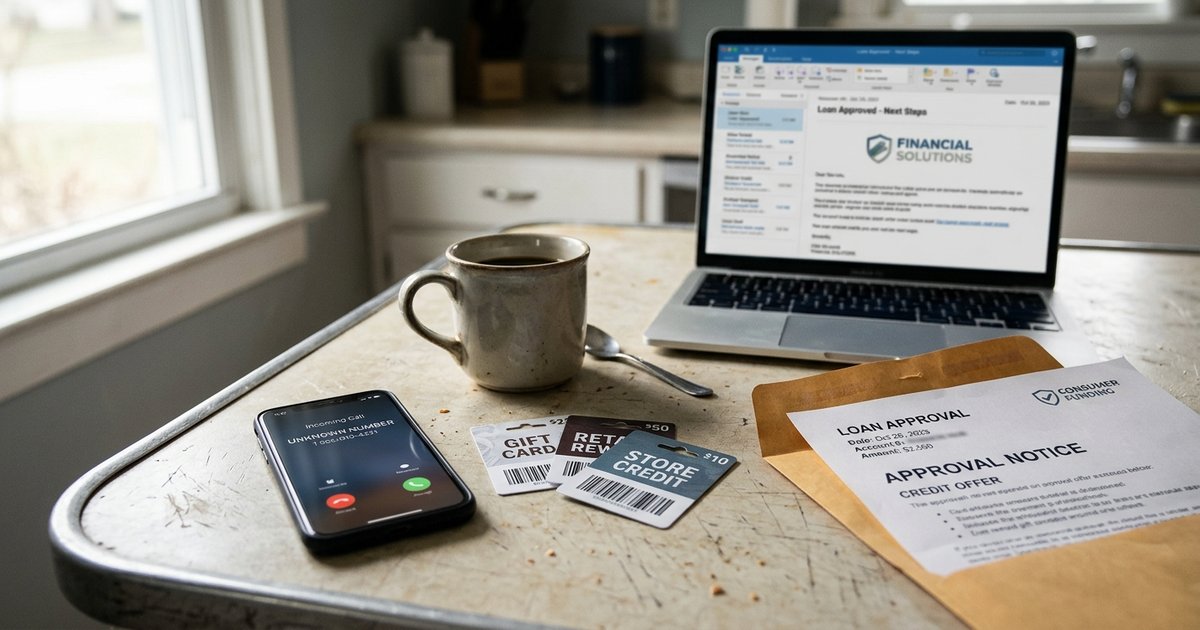
The DocuSign envelope arrives at 11:14 on a Wednesday morning. The logo at the top looks close enough to a real lender's that you do not look twice. You are "approved" for $8,000, the email says, pending a $389 "insurance verification fee" payable in Apple gift cards. The agent on the phone is patient. He has your name spelled correctly, knows the city you live in, and tells you the funds will hit your checking account within an hour of the fee being processed. He asks, gently, whether you would like him to stay on the line while you walk to CVS.
That is an advance-fee loan scam. It is one of the most common consumer fraud patterns in the country, and it concentrates on the same borrowers legitimate lenders often turn down: bad credit, urgent need, first-time applicants. The CFPB took in millions of consumer complaints in 2025, and fraud and scams showed up across nearly every product category. The FTC took action in July 2025 against a debt-relief outfit called Accelerated Debt for an advance-fee scheme targeting seniors and veterans, which is a useful reminder that the same script is running today, this week, against somebody you know.
This piece is a field guide. The goal is to teach you to recognize the scam in motion, before you wire anything, and to give you the steps to take if you already did. We are going to skip the dry "be careful out there" warnings. You need the actual scripts, the actual payment methods, and the actual decision moment.
How an advance-fee loan scam actually works
The pattern, in order, is almost always the same:
You apply somewhere (a real lender, a comparison site, or a "free quote" form), or you simply search "guaranteed approval bad credit." Within hours or days, you get a call, an email, or a text from someone claiming to be a lender. They have your name, sometimes your address, sometimes the last four of your Social Security number from a prior breach. They tell you you are approved. The numbers are bigger than what you applied for. The rate is suspiciously good. There is just one small step before the funds release.
That small step is always a fee, and the fee is always paid through a method that cannot be reversed: gift cards, cryptocurrency, wire transfer, or peer-to-peer apps like Zelle or Cash App. The fee will be called something that sounds plausible: "insurance fee," "first and last payment," "verification fee," "tax fee," "collateral hold," "good faith deposit." It does not matter what they call it. A real lender does not require the borrower to send money to receive a loan.
You pay. The funds do not arrive. There is one more fee. Then another. The phone number is out of service by the end of the week.
Nine red flags that mean you are about to be robbed
Memorize these. Any one of them is enough to stop the conversation.
- Any upfront fee paid to the "lender" before funds are issued. Origination fees on real personal loans are deducted from the disbursement or financed into the principal. They are never paid out of pocket via gift card or wire before the loan funds.
- Payment by gift card, cryptocurrency, wire transfer, or Zelle. The FTC has flagged gift cards and crypto as payment methods used "almost exclusively" by scammers. No legitimate financial institution asks for a gift card. Ever.
- "Guaranteed approval, regardless of credit." No real lender guarantees approval before underwriting your application. The phrase itself is the tell.
- No physical address, no verifiable license. Real lenders are licensed at the state level. You can search NMLS Consumer Access at nmlsconsumeraccess.org and your state banking or financial-services regulator's database. If neither shows the company, that is a problem.
- Pressure to decide in minutes. "This offer expires at the end of the call." Real lenders will email you written disclosures and let you sit with them. Truth in Lending Act disclosures are not allergic to thinking.
- Email from a free domain. "loanofficer.smith@gmail.com" is not a real lender's email. Legitimate institutions send from their corporate domain. Look at the address, not the display name.
- A name that looks like a real lender, but slightly off. "SoFi Lending Group LLC" instead of "SoFi." "Discover Financial Services Inc." instead of "Discover." The lookalike is intentional. Search the exact name plus the word "scam" before you do anything else.
- Refusal to disclose APR, fees, or terms in writing. The Truth in Lending Act and Regulation Z require the APR, finance charge, total of payments, and payment schedule to be disclosed before you sign. A "lender" who waves that off is not a lender.
- They called you first, about a loan you never applied for. Cold calls and unsolicited "pre-approval" texts for loans you did not initiate are a near-universal fraud signal. Real lenders do not chase strangers with $8,000 offers.
How to verify a lender in 90 seconds
Before you send a dollar, do this:
NMLS Consumer Access (nmlsconsumeraccess.org). Search the company name and any individual loan officer's name. The Nationwide Multistate Licensing System lists licensed lenders and brokers. Not every consumer lender is in NMLS, but most legitimate ones are.
Your state regulator. Every state has a banking or financial-services regulator with a searchable license database. Connecticut's Department of Banking, Washington's Department of Financial Institutions, California's DFPI, and so on. Search "[your state] department of banking lender license search."
The CFPB complaint database (consumerfinance.gov/complaint). Public, searchable. If a company has a long pattern of complaints, you will see them.
Better Business Bureau and Google. Search the exact company name plus "scam," "complaint," and "FTC." If the FTC has taken action, the press release usually surfaces. Several borrowers in real-life cases have told reporters the same thing afterward: "I googled the name and the FTC release came up. I wish I had done it two hours earlier."
Real lender versus fake lender, side by side
A real lender:
- Sends Truth in Lending disclosures (APR, finance charge, total of payments) before you sign anything.
- Lists a physical address and a state license number you can verify.
- Charges origination or other fees out of the loan proceeds, not out of your pocket beforehand.
- Accepts payment by ACH from your bank account (your routing number and account number), not by gift card or wire transfer to an individual.
- Does not "guarantee" approval before underwriting.
- Will let you call back tomorrow.
A fake lender:
- Sends a polished "approval" letter with a real-looking logo and no verifiable disclosures.
- Has a phone number that goes to voicemail outside business hours, or to nothing at all.
- Insists on gift cards, crypto, wire, or Zelle for any "fee."
- Promises funding in an hour, or in 30 minutes, contingent on the fee clearing.
- Pressures you to stay on the phone while you walk to a store to buy gift cards.
- Disappears the moment you push back or ask to verify them with the state regulator.
(For the underwriting reality these scams imitate, see our walkthrough on why pre-approved loans get denied at final underwriting.)
If you already paid: what to do in the next hour
Step 1: Call your bank or your card issuer immediately. Wires can sometimes be recalled if you act within hours. Zelle is largely treated as authorized by the bank, but file the dispute anyway, because some banks will refund as a courtesy or are bound by guidance on Regulation E coverage of authorized-but-fraudulent transfers. Cards (debit and credit) have stronger consumer protections under Regulation Z and Regulation E; dispute the charge as fraud.
Step 2: If you paid with gift cards, call the card issuer (Apple, Google, Amazon, Walmart, Target). Some retailers will freeze a card if it has not been redeemed yet. Most will not refund once it is, but the call is still worth making.
Step 3: Report. File with the FTC at ReportFraud.ftc.gov, with the CFPB at consumerfinance.gov/complaint, with your state attorney general, and with the FBI's Internet Crime Complaint Center at ic3.gov for any wire or crypto loss. Keep every email, every text, every screenshot. Save the phone numbers they called from.
Step 4: Place a fraud alert or a credit freeze. The scammer has your personal information. Call any one of the three major bureaus (Experian, Equifax, TransUnion); the alert propagates to the others. A credit freeze is free, takes minutes, and stops new accounts from being opened in your name.
Step 5: Consider an identity-theft report at IdentityTheft.gov if you shared your Social Security number, date of birth, or driver's license number. The site walks you through a recovery plan tailored to what you disclosed.
Why these scams target the borrowers who can least afford them
The scammers buy lead lists, scrape "guaranteed approval" search traffic, and target borrowers whose recent application data is fresh. CFPB complaint data shows installment-loan complaints make up a meaningful share of personal-lending complaints, and many of those describe the same pattern: a desperate applicant, a lookalike "lender," a fee that has to be paid in gift cards, and silence afterward. (The borrowers most often hit are also the ones doing things like the order of operations in our 72-hour emergency cash playbook, which is exactly when a fraudster's "guaranteed approval" pitch is most tempting.)
The federal regulators do enforce. The FTC's Telemarketing Sales Rule prohibits charging upfront fees for credit improvement or loan brokering offered over the phone. The 2025 action against Accelerated Debt is an example, not a one-off. But enforcement happens after the loss. The protection that actually saves you is at the moment the fee is requested.
How Trust Point Loans fits scam-proofing
We are not a lender. We help borrowers connect with the right type of funding for their situation, and a legitimate connection service never asks for a fee paid to a "lender" before funds are issued. If a site or a caller tells you Trust Point Loans (or any service like it) requires you to pay a fee in gift cards or crypto to "release" your loan, that is somebody using our name in a scam. Report it to us at our contact form, and report it to the FTC.
The single sentence to remember when an offer feels too good and the agent is pushing you toward CVS: a real lender takes money out of the loan, not out of your pocket beforehand. If they want gift cards, they are not a lender.
Common questions about loan fee scams
Are origination fees on personal loans the same as advance fees?
No. A real origination fee is deducted from your loan disbursement (you receive the principal minus the fee) or rolled into the loan balance. You never pay it separately, in cash or by gift card, before the loan funds. Regulation Z requires it to be included in the disclosed APR.
Can a legitimate lender require a "first and last payment" upfront?
No. That is a real-estate concept (security deposits in renting), not a personal-loan concept. A real lender does not collect future loan payments before issuing the loan.
I gave them my checking account info but did not pay a fee. What now?
Call your bank, change the account, ask about ACH blocks on the relevant account. Pull your credit reports and consider a freeze. File a CFPB complaint. The risk is not just the fake "loan" but the use of your account information for unauthorized debits.
Can I get my money back if I paid in gift cards?
Sometimes, if the cards have not been redeemed yet. Call the gift card issuer (the FTC publishes the relevant numbers) immediately. Once redeemed, recovery is rare. Reporting still matters because it feeds enforcement action and may help other victims.
Where do I report a loan scam?
FTC at ReportFraud.ftc.gov, CFPB at consumerfinance.gov/complaint, your state attorney general's consumer protection office, the FBI's IC3 at ic3.gov for wire or crypto loss, and your bank or card issuer. File with all of them. The reports do not duplicate; they go to different enforcement and recovery channels.