
Quick answer: Personal loan APRs in 2026 are barely tracking the Fed's rate cuts because the credit risk premium (the spread lenders charge for expected losses) widened sharply during 2024 and 2025. Until charge-offs cool, even another 75 basis points of Fed easing will move prime personal loan rates by tens of basis points, not hundreds.
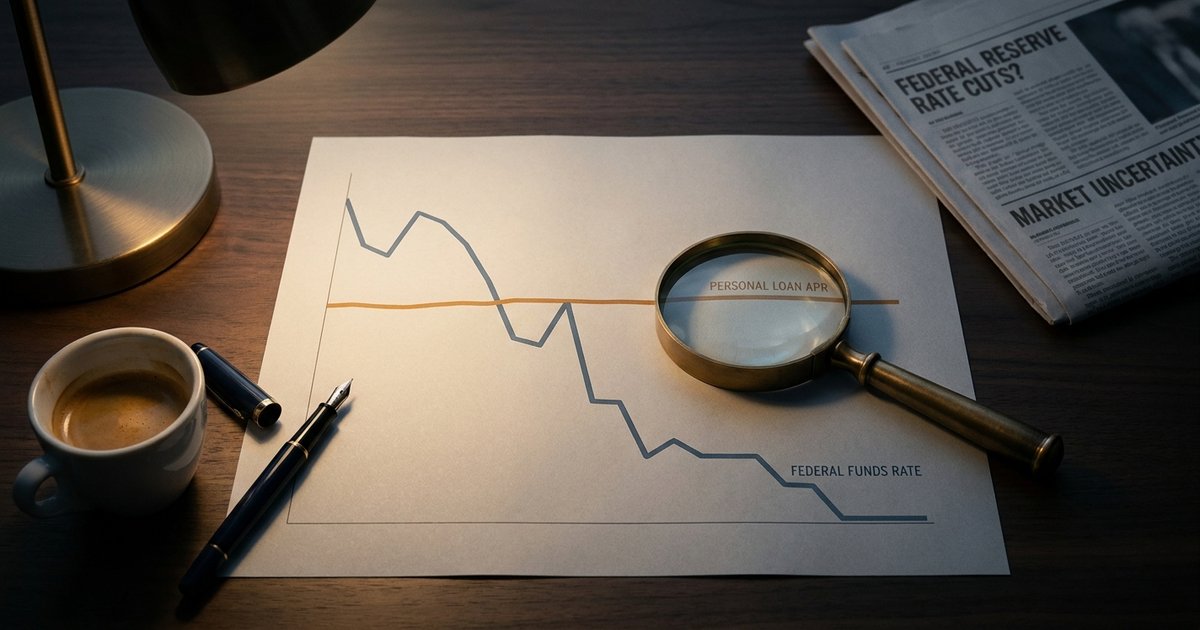
The federal funds target sits at 3.50 to 3.75 percent. The average personal loan APR at commercial banks was 11.40 percent in February 2026, according to the Federal Reserve's G.19 consumer credit release. For prime borrowers shopping this month, Credible's weekly tracker pegs the average 3-year personal loan APR at 13.45 percent and the 5-year average at 17.79 percent. The Fed has cut three times since late 2025. Your loan offer probably looks almost identical to the one you would have seen last October.
If that frustrates you, fair. It should. But the spread between the federal funds rate and what you actually pay on an unsecured personal loan is not a glitch, and it is not lender greed in any simple sense. It is how unsecured consumer credit gets priced. Here is what is actually moving underneath the headlines.
The Fed cuts a rate. It is not your rate.
The federal funds rate is what banks charge each other for overnight reserves. That number ripples through the economy, but it touches different lending products with very different force. A HELOC tied to prime moves almost in lockstep. A 30-year fixed mortgage cares more about the 10-year Treasury than the Fed's overnight rate. A variable credit card adjusts within a billing cycle or two.
An unsecured personal loan? It is one of the loosest links in the chain. The Fed rate is one input into a lender's cost of funds, and cost of funds is only one input into your APR.
Here is the rough breakdown of what goes into the rate you are quoted:
- Cost of funds. What it costs the lender to raise the money it lends you. Yes, this tracks the Fed loosely.
- Credit risk premium. The expected loss on loans like yours. This is the big one for unsecured credit, and it has been climbing.
- Operating cost. Underwriting, servicing, fraud, collections.
- Target margin. What the lender wants to earn after the first three line items.
The Fed cuts move the first input. The second input has been doing most of the heavy lifting recently, and it has been pulling in the opposite direction.
Charge-offs are why your rate did not drop
Charge-off rate is the share of outstanding loan balances that lenders write off as uncollectable. When charge-offs rise, lenders rebuild their risk premium by raising APRs on new originations. That happened across 2024 and into 2025. Net charge-off rates on consumer loans at commercial banks pushed above pre-pandemic norms (FRED series CORCACBS), and unsecured personal loan charge-offs at the largest fintech originators ran higher still.
Translation: the people who borrowed in 2022 and 2023 did not pay back at the rate lenders priced for. So when underwriters set rates for 2026 borrowers, they are still pricing in defensive spread. A 25-basis-point cut from the Fed barely registers against a credit risk premium that widened by several hundred basis points over two years.
This is also why the "average" rate is misleading. A 12 percent average is a weighted blend of prime and subprime. Bankrate's average personal loan rate tracker shows the prime borrower average sitting in the low teens, while a 620 FICO borrower at the same lender is being quoted 28 to 35 percent. That subprime end has not really changed since 2024.
The spread, in plain numbers
The gap between the federal funds rate and average personal loan APRs has not been this wide in a normal-rate environment in years. Look at the rough picture:
- Federal funds target rate: 3.50 to 3.75 percent (FOMC, March 2026).
- Commercial bank 24-month personal loan, average APR: 11.40 percent (Federal Reserve G.19, February 2026).
- FICO 720 plus, 3-year personal loan, average APR: 13.45 percent (Credible, week ending May 3, 2026).
- FICO 720 plus, 5-year personal loan, average APR: 17.79 percent (Credible, same week).
- Subprime tier (roughly 580 to 640), typical APR range: 24 to 36 percent at most online lenders.
The implied spread for a prime borrower over the federal funds rate is roughly 10 to 14 percentage points. That is wide. In 2018 and 2019, when the funds rate was around 2.25 to 2.50 percent, prime personal loan averages sat closer to 10 to 11 percent. Today's spread is several points fatter, almost entirely because of credit risk repricing. NerdWallet's tier-by-tier rate breakdown tells the same story across credit bands.
Should you wait six months to apply?
This is the question I get asked most, and the honest answer is: probably not, but it depends on what the loan is for.
Bankrate's 2026 forecast pencils in three more 0.25 percent cuts this year. The Fed's own dot plot, last updated in March, only projects one. Even if Bankrate is right and the dot plot is wrong, you are looking at maybe 75 basis points of further easing. That moves the funds rate. It does not move your personal loan APR by 75 basis points. Based on how the last three cuts transmitted, you might see 20 to 40 basis points off the average for prime borrowers if charge-off trends keep cooling. For subprime, even less.
Now run the math the other way. If you are carrying a $12,000 credit card balance at 24 percent APR while you wait, every month costs you roughly $240 in interest. A 0.30 percent improvement in your eventual loan APR on a $12,000 personal loan saves you about $36 a year. The card interest will eat that several times over before any new cut shows up in lender pricing. (For the deeper version of this trade-off, see our breakdown of when debt consolidation actually makes the math worse.)
The case for waiting is real only in two situations: you do not have an urgent need, and your credit profile is actively improving (utilization dropping, accounts aging in, no new derogatories). In that case, six months of profile improvement will move your rate more than another Fed cut will.
How to actually get a lower rate this quarter
If you are shopping right now, the levers that matter are the ones inside your application, not the ones at the FOMC. In rough order of impact:
- Pull your credit utilization below 30 percent, ideally below 10. This is the fastest score lever most borrowers ignore. Pay cards down before the statement closes, not after.
- Shorten the term. A 36-month loan almost always prices below a 60-month at the same lender. The Credible data above shows roughly 430 basis points between the 3-year and 5-year average for prime borrowers.
- Add a co-signer or co-applicant. If your credit is the binding constraint, this is the single biggest rate-mover available to you, often 300 to 600 basis points. Read our walkthrough on asking someone to cosign a loan without ruining the relationship before you have that conversation.
- Consider a secured option. Share-secured loans at credit unions price dramatically lower because the credit risk premium is mostly removed.
- Soft-pull pre-qualify at three or four lenders before any hard pull. Pre-qualification offers do not affect your score and let you see real, personalized numbers. Our full guide on soft-pull versus hard-pull pre-qualification walks through the mechanics.
And one more thing worth saying out loud: ignore the "rates are dropping, refinance now!" subject lines in your inbox. Those are marketing funnels. The actual repricing happening underneath them is small, slow, and very uneven across the credit spectrum.
Why the rate spread matters for your loan
If you take one thing from the data above, take this: your APR in 2026 will be set far more by your file than by the Fed. The macro story is real, but the macro story is also small relative to the credit-risk story. Spend an hour cleaning up utilization, get pre-qualified at multiple lenders without a hard pull, and pick the term length that keeps your monthly payment manageable without dragging the loan out for five years. That sequence will save you more money than waiting for the next FOMC meeting.
Common questions about 2026 personal loan rates
Why did my personal loan APR not drop after the Fed cut rates?
Personal loan APRs are not directly tied to the federal funds rate. Lenders price them off cost of funds plus a credit risk premium plus operating cost plus margin. The credit risk premium has stayed elevated because charge-off rates rose in 2024 and 2025, which mostly canceled out the effect of the three Fed cuts in late 2025.
What is the average personal loan rate in 2026?
The Federal Reserve's G.19 release pegged the average APR on a 24-month commercial bank personal loan at 11.40 percent in February 2026. Credible's weekly tracker showed 13.45 percent for 3-year loans and 17.79 percent for 5-year loans for borrowers with FICO 720 and above in early May 2026. Subprime borrowers commonly see 24 to 36 percent.
Will personal loan rates drop in 2026?
Most likely yes, but only modestly. Bankrate forecasts three more 0.25 percent Fed cuts in 2026 while the FOMC's own dot plot projects one. Either way, the pass-through to personal loan APRs has been small, so expect single-digit basis-point movements per cut, not large declines.
Should I wait to take out a personal loan?
Only if you have no urgent need and your credit profile is actively improving. If you are carrying high-interest credit card debt while you wait, the interest you pay on that debt almost always exceeds what you would save by getting a slightly lower personal loan rate later.
Does the Military Lending Act cap my personal loan rate?
The Military Lending Act caps APR at 36 percent (MAPR) for active-duty servicemembers and their dependents, regardless of state. It does not apply to civilian borrowers, who are subject to state-level usury rules instead.