
Quick answer: A 20 to 30 point credit score drop after paying off an installment loan is normal. Closing the loan flipped the account from active to inactive, which moved two FICO scoring factors at once (credit mix and the average age of your active accounts). The dip almost always recovers within three to six months as long as your other accounts stay in good standing.
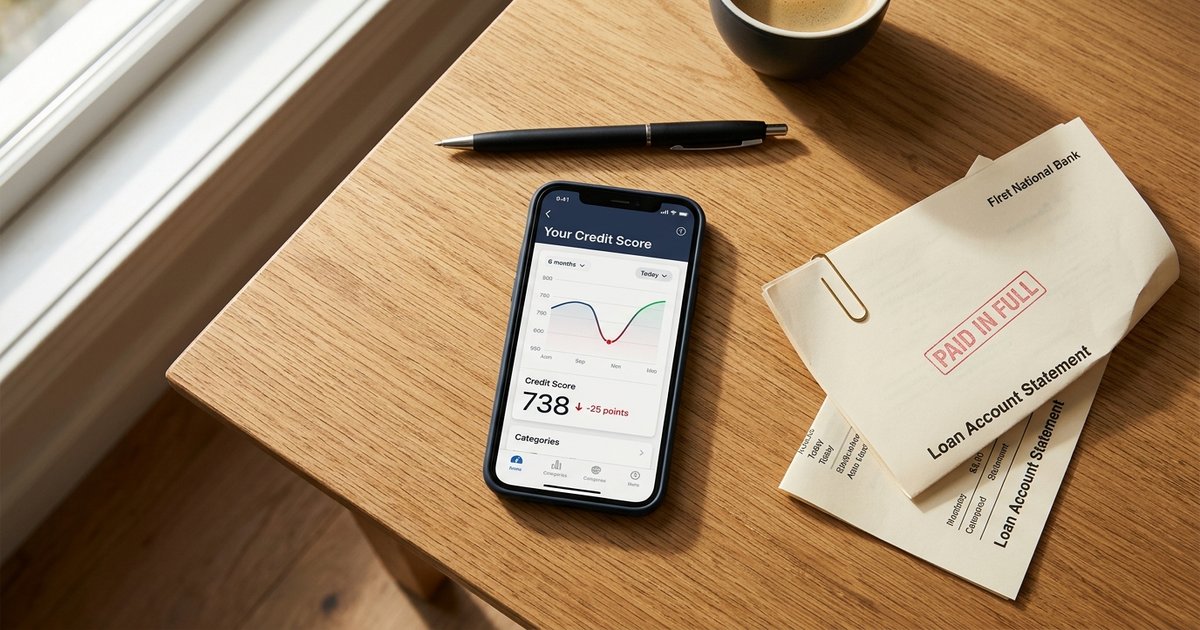
You made the last payment. The account closed. You opened your credit app expecting a little victory lap, and instead your score dropped 22 points. Maybe more. Your first thought was probably some version of: I just did the responsible thing. Why am I being punished for it?
You're not. I promise. What you're seeing is a quirk of how credit scoring models read your file, not a verdict on your financial choices. Let's walk through exactly what changed, why it moved your score, and roughly how long it takes to bounce back.
The 30-second answer on the score drop
Yes, it's normal. A lot of people see a 20 to 30 point drop after closing the only active installment loan on their report, especially if they only had one or two open accounts to begin with. The drop isn't a penalty. It's the score reacting to a real change in your file: you have one fewer active account, and the mix of credit types you're actively managing just got smaller.
The recovery usually shows up within a few months as long as your remaining accounts stay in good standing. Nothing you need to fix. Nothing broken.
What actually changed in your file
Before the payoff, your credit report had an open installment loan reporting a balance, a monthly payment, and an on-time payment streak. After the payoff, that account flips to "closed, paid as agreed." It's still on your report. It still counts toward your payment history. But it's no longer an active, working account.
That single status change can move two of the five FICO scoring factors at once.
The two factors that moved
FICO breaks your score into five buckets, weighted like this (straight from myFICO's official scoring breakdown):
- Payment history: 35%
- Amounts owed: 30%
- Length of credit history: 15%
- New credit: 10%
- Credit mix: 10%
When you closed your loan, two of those buckets shifted. Credit mix is the obvious one. If that loan was the only installment account on your file (everything else was credit cards), your file just lost its variety. FICO likes seeing that you can responsibly handle both revolving credit (cards) and installment credit (loans). Lose the installment side, and the mix factor takes a hit. myFICO's own walkthrough spells out why those two debt types are weighted so differently.
The second factor is sneakier: the average age of your active accounts. Closed accounts are still counted in some scoring models, but newer FICO models lean more heavily on what's currently open. If your loan was a few years old and you closed it, the average age of your active accounts just got younger. Younger accounts mean a slightly riskier-looking file.
Neither change is huge by itself. Together, they explain most of the drop. (For the related case where it is a card balance, not a loan, doing the damage, see why a small credit card balance hurts your score more than a big car loan.)
Why a closed account isn't "gone" but isn't "working" either
Here's the part that confuses almost everyone. According to Experian's explainer on score drops after payoff, a closed installment account in good standing can sit on your credit report for up to 10 years. So in one sense, the loan is still helping you. Its on-time payment record is still in your file, still padding your payment history.
But the score doesn't treat closed accounts the same as open ones. A closed account can't show new on-time payments. It can't contribute to your active credit mix. It's a trophy on the wall, not a player on the field. Useful, just not in the same way.
A realistic recovery timeline
I'll be honest: nobody at FICO has published a "your score will recover by X date" chart, and any article that pretends otherwise is making it up. What we do know, from Equifax's explainer on why a credit score can drop and a lot of myFICO forum data, is that most drops self-correct within a few months as long as you keep doing the boring stuff right.
Roughly what you can expect:
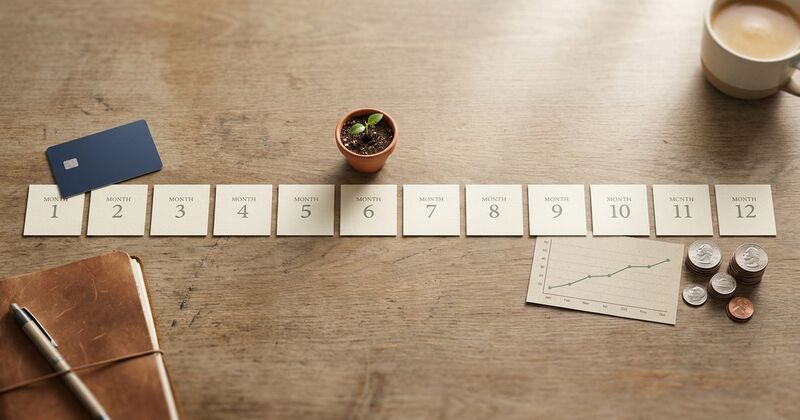
- 30 days: The closed status is now reported across all three bureaus. Score may still feel sore. Don't apply for new credit just to "fix" it.
- 60 to 90 days: If your credit cards are reporting low balances and you haven't added new debt, you'll usually see the first 5 to 10 points come back.
- 3 to 6 months: Most of the original drop is recovered, assuming nothing else changed. Some borrowers see their score climb past where it was before the payoff once a couple of card statement cycles report under 10% utilization.
- 6 to 12 months: If you eventually open a new installment account (a car loan, a personal loan, a credit-builder loan) for unrelated reasons, the credit mix factor recovers fully.
That last one is important, and I want to say it carefully: don't go open a loan you don't need just to chase 10 points of credit mix. That's not a smart trade. The mix recovers naturally over time. Pay for credit when you actually need credit, not to game a score.
What to do (and not do) in the next 90 days
Here's the short list:
- Keep your credit cards open and active. Run a small charge through each one every month or two and pay it off in full. Issuers sometimes close cards you stop using.
- Get your card balances reporting under 10% of your limit. This is the single fastest lever you have. Pay the card down a few days before the statement cuts, not after.
- Don't apply for new credit just to "rebuild the mix." A hard inquiry plus a brand-new account can dent your score short-term and won't help faster than just waiting.
- Don't dispute the closed account. The closure is accurate. Disputing it goes nowhere and wastes your time.
- Pull your free credit reports at AnnualCreditReport.com. Make sure the closed loan reports as "paid in full" with no late marks. If it doesn't, that's worth disputing.
When the drop is actually a problem versus just cosmetic
If you're not applying for anything in the next 6 months, the drop is cosmetic. Annoying to look at, but it doesn't change your life. Your score will recover on its own.
If you're about to apply for a mortgage, an auto loan, or a personal loan in the next 60 days, the drop matters. A 25 point dip can move you from one rate tier to the next, which can cost real money over the life of the loan. In that case, two options: wait a few months for the score to settle, or apply with the score you have and accept that the rate will reflect today's number. (If your number is borderline, our walkthrough on the 30-day credit sprint before a loan application lays out the levers that actually move quickly.)
One more thing worth knowing. If you check your score in two different apps and the numbers don't match, that's not a glitch. FICO and VantageScore handle closed accounts a little differently, and a single payoff can move them by different amounts. Pick one model to track over time and ignore the other for trend purposes. Most lenders use FICO.
The reframe on a healthy payoff
You didn't get punished for paying off your loan. You watched a scoring model react to a normal, healthy change in your credit file. The same model will react in your favor again as your remaining accounts age and your card balances stay tame.
If you'd kept the loan open just to protect your score, you'd be paying interest on debt you didn't need to carry. That's a much worse trade than a temporary 25 point dip. You did the right thing. The score will catch up.
Common questions about a score drop after payoff
Should I have kept the loan open instead of paying it off?
No. Paying interest on a loan you could've cleared just to protect a credit score is almost never worth it. The cost of carrying debt is real money. The score drop is temporary and cosmetic for most people.
Does this happen when I pay off a credit card too?
It's different. Paying down a credit card almost always helps your score because it lowers your utilization. The drop only tends to show up if you actually close the card after paying it off, which removes available credit and can spike your overall utilization on the cards you have left.
How long does the closed loan stay on my credit report?
Closed installment accounts in good standing can stay on your report for up to 10 years, according to Experian. The on-time payment history keeps helping your "payment history" factor that whole time, even though the account isn't active.
Will opening a new loan reverse the drop faster?
Sometimes, but it's not a clean win. A new loan adds an inquiry and lowers the average age of your accounts, both of which can hurt short-term. Only open a new loan if you actually need the money. Don't borrow to chase a score.
My drop was 60+ points, not 20 to 30. Is something else going on?
Probably. A drop that big usually points to something beyond the payoff: a high credit card balance reporting at the same time, a late payment posting, a charge-off, or a closed credit card reducing your total available credit. Pull your free reports at AnnualCreditReport.com and look for what else changed in the same window.
Does this hit FICO and VantageScore the same way?
Not exactly. VantageScore and FICO weight closed accounts and credit mix slightly differently, so the same payoff can move the two scores by different amounts. If you see a bigger drop in one app than another, that's why.